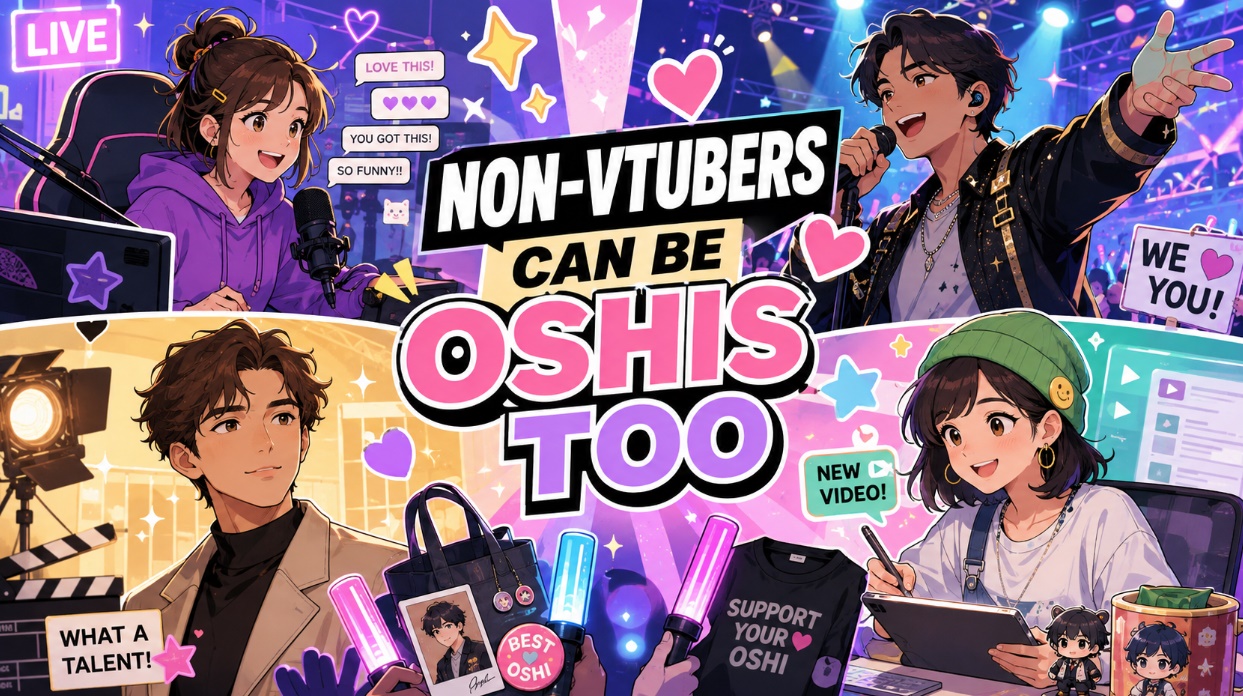
When people hear the word oshi, especially in online fandom spaces, the first thing that probably comes to mind is a VTuber, an idol, or maybe a character from a gacha game. And sure, that makes sense. The word gets used a lot in those communities. But here’s the thing: your oshi absolutely does not have to be a VTuber.
Honestly, an oshi can be pretty much anyone you feel that special kind of fan attachment to.
- A singer? Oshi.
- An actor? Oshi.
- A streamer who has never touched a Live2D model in their life? Oshi.
- A professional wrestler, esports player, YouTuber, voice actor, artist, comedian, or random internet personality whose posts somehow make your day better every single time?
- Yep. Oshi.
So… What Even Makes Someone an Oshi?
There isn’t really a strict checklist. It’s not like you need to fill out a form saying:
- “Do I own at least three pieces of merch?”
- “Have I watched 200 hours of their content?”
- “Have I spent an irresponsible amount of money on acrylic stands?”
If the answer is no, congratulations: you can still have an oshi.
For me, the word feels less like “this is a person I like” and more like “this is my person in this particular fandom space.” You know the feeling. You see their name in a notification and immediately click.
They announce a new project and suddenly you care about a genre you’ve never cared about before. Someone asks who your favorite is and you don’t even need to think about it.
That’s oshi behavior.
The VTuber Connection Is Strong, But It’s Not the Whole Story
VTuber culture has definitely helped make oshi a common word among international fans. You’ll hear people talk about their kamioshi, their oshimen, their oshi marks, birthdays, merch, memberships, concerts, and so on.
Because of that, it can sometimes feel like “oshi” belongs specifically to VTubing. But the idea of oshi existed long before VTubers became huge.
The term is deeply connected to Japanese idol fandom, where fans would “push” or support a particular member of a group. Over time, its use expanded, and now people use it for all kinds of performers, creators, characters, athletes, and public figures.
So if your favorite creator is a regular facecam streamer with zero anime lore, you are not breaking some sacred fandom law by calling them your oshi. The Oshi Police are not coming for you.
Probably.
Favorite and Oshi Don’t Always Feel the Same
Technically, you could translate oshi as something like favorite or “the person you support”.
But emotionally? It can hit a little differently, you can have lots of favorites.
You might like ten musicians, five streamers, twenty fictional characters, and one actor whose entire filmography you somehow watched in a weekend, but an oshi often comes with a stronger sense of attachment.
There’s usually some kind of active support involved, you want to see them succeed, you get excited when they get new opportunities, you recommend them to friends, you buy their album, watch their streams, go to their events, repost their work, or just quietly cheer for them from your little corner of the internet.
It’s less “I enjoy this person’s content” and more: I am emotionally invested in your success now. Sorry, I don’t make the rules.
Your Oshi Doesn’t Need to Know You Exist
This one should probably be obvious, but it’s still worth saying. Having an oshi does not mean you have some kind of personal relationship with them.
- They don’t have to recognize your username.
- They don’t have to follow you back.
- They don’t need to know your name, your birthday, or that you watched their three-hour interview from 2019 at 2 a.m.
Being a fan is enough. Actually, keeping that distinction in mind is part of having a healthy fandom experience. You can care a lot about someone’s work while still remembering that they are a real person with their own life, boundaries, relationships, and private world outside of what they share publicly.
Your attachment can be meaningful without being mutual, that doesn’t make it fake, it just makes it fandom.
And Yes, Your Oshi Can Be “Unexpected”
One of the funniest things about having an oshi is that sometimes you absolutely do not choose them, you start watching someone casually. “They’re pretty funny”, you think.
Then you watch another video, then another, you learn their entire career history, you recognize their voice in two seconds, your friends send you clips of them without explanation because they already know and at some point, you have to admit what happened: That person got you.
And it doesn’t matter if they’re a VTuber, a musician, a Formula 1 driver, a Broadway actor, a football player, a chef on YouTube, or some guy who makes extremely specific video essays about 1990s computer games, the pipeline is the pipeline…
Fandom Language Is Allowed to Evolve
Sometimes people get very serious about fandom vocabulary, and yes, understanding where words come from matters. Cultural context matters too.
But language also travels, people borrow words because they describe feelings or experiences that their own language doesn’t capture quite as neatly, Oshi is one of those words.
- For a lot of fans, saying “my favorite” feels too casual.
- “My idol” sounds weird if the person is, say, a Twitch streamer who spends six hours yelling at a horror game.
- “My celebrity crush” definitely means something else.
- “My parasocial fixation” sounds like you’re about to present a PowerPoint to your therapist.
Sometimes oshi just fits.
Basically: Oshi Is a Feeling
You don’t need a VTuber model / You don’t need idol music / You don’t need a penlight, an ita bag, or a shelf full of merch / You don’t even need to spend money.
If there’s a creator, performer, athlete, artist, or public figure you feel especially attached to supporting, calling them your oshi makes perfect sense, fandom is already full of oddly specific emotions, we might as well use the words that make those emotions easier to explain.
So yes.
Non-VTubers can be oshis.
- Your favorite actor can be your oshi.
- Your favorite singer can be your oshi.
- Your favorite streamer can be your oshi.
And if you’ve already built an entire folder of reaction images featuring them?
Yeah.
I think we both know what’s going on.